Meet the Filmmakers: From Personal Stories to Collective Realities
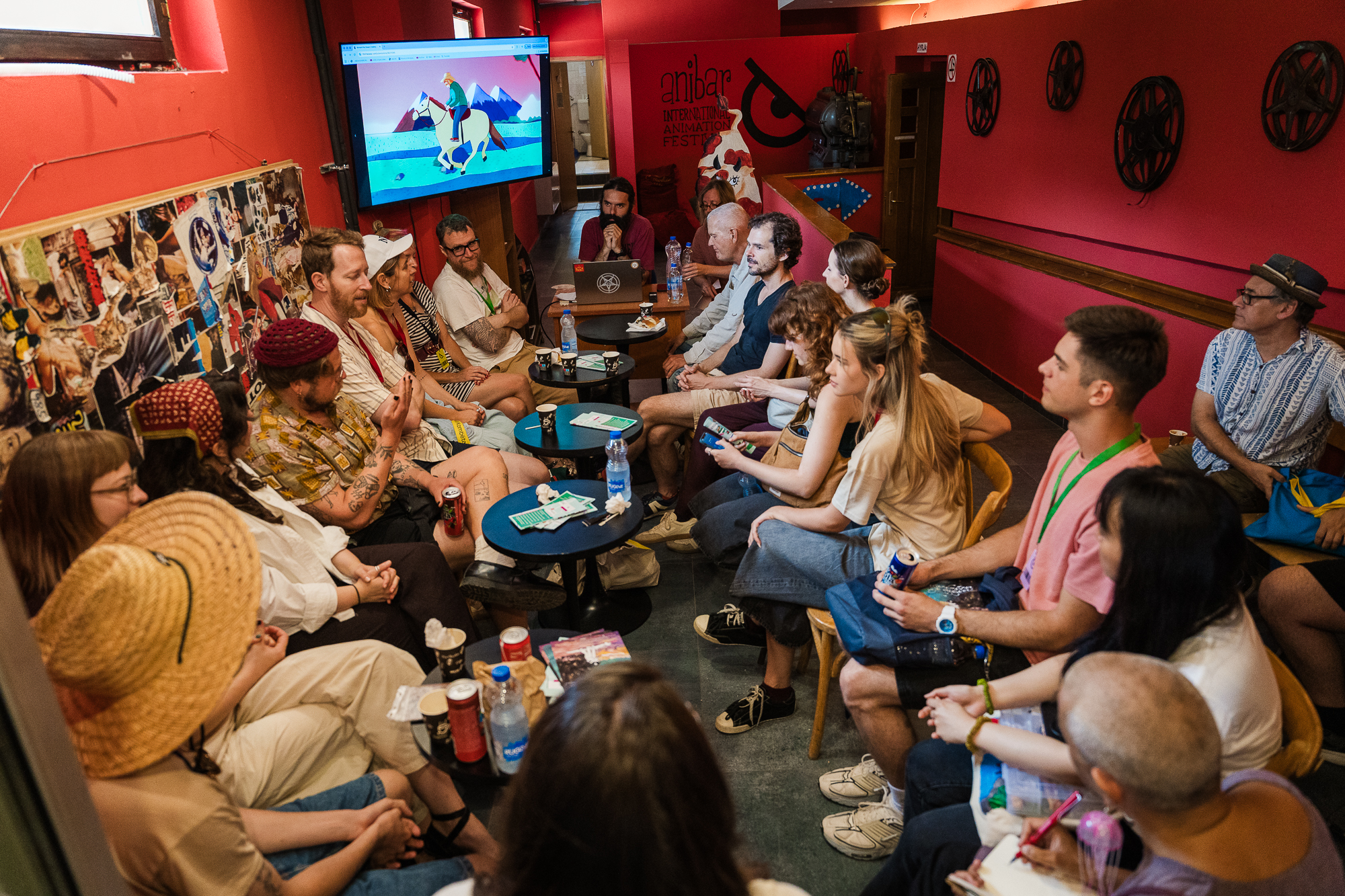
Anibar presents two young female animation filmmakers whose works were featured in the Human Rights Program: Ukrainian director Polina Piddubna and Kosovo director Siera Deshishku.
These courageous storytellers grapple with complex social issues, giving a voice to those often unheard and revealing the realities of the countries they come from. Read more about their films, creative processes, the journeys that brought these stories to the screen, and the impact their work has made.
My Grandmother Is a Skydiver, by young Ukrainian director Polina Piddubna, is a deeply personal animation dealing with war, displacement, colonialism, and the resilience of women across generations. Through the story of Alfyia, a joyful young woman in 1960s Central Asia who studies to become a midwife while practicing skydiving, the film creates a conversation between past and present. In 2022, Alfyia receives a phone call from her granddaughter, who is worried about her safety during the full-scale invasion of Ukraine. Through this intergenerational connection, the granddaughter reexamines family memory, ethnic identity, collective trauma, and the meaning of human life. The film was screened at Cannes and received strong festival recognition.
With Polina, we discussed the process of transforming her family story into a film, her personal journey behind its creation, and the experience of traveling to festivals while sharing stories connected to Ukraine’s complex historical and political realities.
“I wanted to make a film about my grandmother initially because, when she was young, she worked as a midwife and also did skydiving as a hobby. Everything started with this motivation to tell a feminist story. But then the full-scale invasion started, and I realized that every generation of my family had gone through wars and displacement. So, I decided to combine these two topics – feminism and war, and make a statement about resilience”.
Talking about developing visual style, she said, “I had many different references that I collected during my anthropological research. These included photographs, archives, paintings, and films. Together with several illustrators, I went through all these materials and developed a unique visual style by using different colors for each location and different shapes, all of which carried specific meanings and moods.”
“Regarding the human silhouettes left in white, at first it was done for technical and production reasons. But later we realized that it served the story as well. There can also be different symbolic interpretations. No matter what situations we go through in life, we remain human; we stay who we are. Because the characters are black and white, people don’t connect them to a specific nation or group. As a result, audiences from different countries and continents can relate to them because they see themselves in the characters. Also, the methods used in wars around the world are often the same. That’s why I wanted to show this repetition, that it happened in the past, and it’s happening all over again, and ask how we deal with it today in order to build a better future.”
Polina described the research process and the experience of interviewing her grandma; “This was the first time I had done such extensive research, and I approached it very intuitively. I spent a lot of time talking with my grandmother. I wasn’t recording our conversations because I never planned to use them directly in the film. I was simply taking notes. I also started reading many different materials because I wanted to understand how everything worked, and what I could show and focus on. While traveling, I often felt very lost. But I kept visiting museums, meeting with artistic and activist communities, talking to people, collecting impressions, taking photographs, and gradually finding my way.”
She also reflected on the identity of her people and the way it is represented in art: “Ukraine is a very international country. There are many people like me with different backgrounds, and everyone is very mixed. But over the centuries, we have developed a strong ability to survive and a great deal of courage. We can see this not only in my work but also in the work of many other artists, contemporary and historical.”
Currently, she is working on her next film, an adaptation of a short novel by Ukrainian writer Mykola Khvylovy, whose writings from the 1920s and 1930s continue to resonate today. “Although his texts are almost a hundred years old, they reflect today’s reality so closely. They contain so much resilience, and many of the things he wrote about are still happening today.”
Discussing the film’s festival journey and conversations with audiences around the world, she described how it feels to share this story internationally. “I feel very happy and privileged to travel the world and share this message. But I also have to deal with a lot of ignorance, many triggering situations, and a great deal of propaganda. I often find myself having to explain very basic facts about the war. When these conversations happen outside Europe, for example in South America or South Asia, it feels understandable. But when I have to explain these things in Europe, it’s really heartbreaking and demotivating.”
1 ROOM, by young Kosovo director Siera Deshishku, is a short documentary portraying families in Kosovo living in extreme poverty, focusing on the emotional and physical realities of everyday life under severe economic hardship. Through intimate moments and personal testimonies, the film gives space to the families’ own voices, creating a portrait based on trust, dignity, and respect rather than exploitation.
Siera studies animation at Leeds Arts University. Her work focuses on real stories and social issues told through intimate, character-driven narratives. She is also an activist, using storytelling to highlight the experiences of people and communities that are often overlooked
She shared the creative process behind One Room, from the first inspiration for the project to the unexpected impact it later had.
“One Room is a documentary about poverty, and the idea came to me after I finished my first year of university in the UK. I went back home to Kosovo for the summer, and when I returned to university in September, we were told we would be making a documentary that semester. The moment I heard that, I knew what I wanted to do. I had just come back from Kosovo, but I thought that I had to go back home. I returned to Kosovo and interviewed families living in poverty.”
“The experience was very personal because no one felt as passionate about the subject as I did. I’m the only one from Kosovo in my class, and I was looking for people to help me, but they didn’t really want to work on this project. So, I had to do it myself.”
Having been involved with an anti-poverty NGO since 2015, Siera had already witnessed the realities faced by many families: “You wouldn’t believe that people live in the circumstances they do. I know I’m privileged, and I wanted to use that privilege to do something for my country.”
“The process was isolating and lasted three to four months, but creatively I felt very free. At the same time, I felt a deep responsibility toward these families because I had told them I was going to make something great out of their stories. It was emotionally very heavy. I cried a lot because I was constantly listening to these stories.”
One moment became the emotional center of the documentary. At the end of the film, a young girl answers a simple question about something she wishes she had: “I asked her, ‘Is there something you want that you don’t have?’ She quietly answered, almost crying, ‘A room.’”
“Selecting what to include in the documentary was difficult because I had hours and hours of footage. I didn’t follow a logical, step-by-step editing process. The passion for the project guided me. I kept asking myself what stood out and what felt important to include. In the end, the little girl brought the whole documentary together. Without her, it would have had much less impact. When I placed her audio at the end of the film, I knew that was it.”
After the film was completed, Siera shared the story behind the documentary on TikTok. It reached hundreds of thousands of people. With support from viewers and public figures who shared the project, she raised funds. Together with her father, she returned to the family’s home, found the builders to expand the house, made rooms for the children, and bought furniture. The girl’s bed arrived on her birthday.
The project was also an important learning experience for her as a filmmaker. She found inspiration in the short film “Souvenirs Souvenirs” (Bastien Dubois), which led her to discover its background painter, George, whose artistic style influenced her own work. “While researching him, I found that he had created illustrations about the war in Kosovo. It felt like a strange coincidence because I had discovered him through a short film, and he had already created work connected to my country, which was also the subject of my own project.”