Meet the Filmmakers: We look into the abyss. The abyss looks back at us
‘Meet the Filmmakers’ invites everyone at Anibar
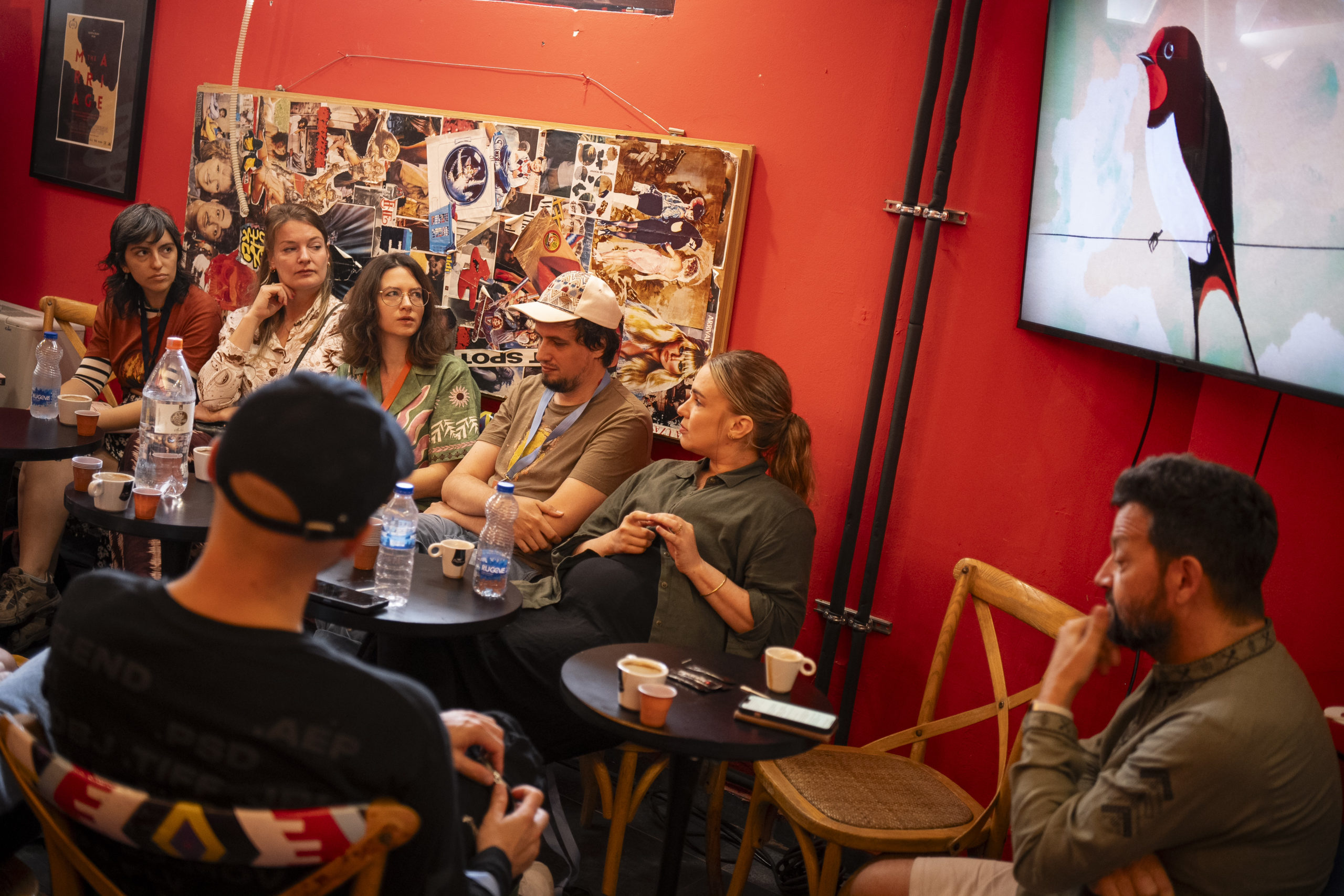
‘Meet the Filmmakers’ invites everyone at Anibar to have a refreshing Balkan-style morning to discuss all that we have watched already at the festival. Filmmakers meet to discuss, and while we are at it, disseminate and dare we say: joke, about everything that has to do with the intricate process of creating an animated film. On Friday, the discussion, moderated by Anastasiya Verlinska and Chris Robinson, brought the experiences of Jenny Jokela, Natasza Cetner, Alex Boya, Krste Gospodinovski, Alejandro Ariel Martin, and Luc Camilli to the heart of the foyer at Kino Jusuf Gërvalla.
From funny incipits to hardcore imagination, to the inevitable way of building a world without rules and then coming back to the roots, tradition, and the utmost sense of yearning, we delved into what could easily be an endless and truthful journey of explaining why humans need to create. We are all made of stories, and it is an impulse as much as it is a necessity to communicate what we absorb from the world.
Starting with Jenny Jokela’s “Dollhouse Elephant”, we opened up with a feeling of coexisting in the same house, the same neighbourhood, while trying to preserve our individuality. Her animation style explodes in colours, adding vivacity to the narration, and that’s her take on this matter: “I’m interested in it because I’m interested in using colour as part of the storytelling. So, for me, I was thinking that all the characters, because all the people in the house see themselves as main characters and see themselves as special. I wanted them all to have different vibrant colours, and then when they come together, either in chaos or more in harmony, like the colours kind of match together in ways that maybe shouldn’t work, but look kind of nice.”
One particular aspect of her film is the soundtrack used, and Jokkela offered her insight: So the idea came from working with the composer on a different project. He’s a big classical music composer in Finland, and I did this, a 25-minute-long film for a piece he did, and it was always performed with a live orchestra, with animation in the background. And it was my first time working with musicians on this scale. And I just loved it, and it was fun and different. “So I had in my mind I’d like to bring it into my work. And then I knew with this film that I don’t want the characters to talk but because the topic of the film is still so much about human nature, I wanted to incorporate the human voice into the film. So then I thought maybe having a non-verbal choir could be funny and stupid and bad.”
From the sweet, tough and sparkly tales of conviviality and drawing inspiration from familiar instances, we had the pleasure to listen to a very important cause of solitary confinement, as portrayed in Natasza Cetner’s “Inside, They Valley Sings” featured in the Human Rights Category. She explained that the film is based upon the reality of confinement in the US, where diversity is a sombre problem, where people sometimes get wrongfully convicted and their perception of reality distorts gravely, as they try to face their accusation in a very complicated, seemingly with no way out legal system.
While explaining the process of getting to know these important yet gut-wrenching stories, where liberty is not a reality, Cetner went on to explain other coping mechanisms on how to keep her workflow intact and focus on portraying the stories with as much truth as possible. Between gardening and watching stand-up comedy shows, in the background relied a sense of uneasiness that would find its articulation in her film, and with it contributed to the impartiality, which that second to the director was essential to the story portrayal.
As rakia and coffee kept being poured, we continued to follow the conversation and get to know more about Alex Boya’s project titled “Bread Will Walk”. His project started in a close relationship with the media and content. He explained to us this process of developing endless images from an object and from them drawing a composite of its iconisation. Just a guide: For all of those who are familiar with Pierce’s work in semiology, might find this concept might be familiar for language, mental imagery and how we define objects as a collective. Or the idea of an object. Alas.
Boya went a little more in-depth and explained a part of the process through his showcase:
There are no windows, no clocks and no hard edges, right? (referring to his film) So this, this idea of this kind of being inside of a snail, right? Being inside a snail shell where there’s nothing in your environment prompts you to have willpower. So this thing is kind of conspiratorial, and going back to your AI thing, ironically, although the process was very social on the one not only on the media consumer side, but also in the production, which meant collaborating with it [..] So it’s a manual process. So what happened is, we were doing this, looking into the abyss. The abyss started looking into us.
Next up, Krste Gospodinovski’s “The Silent Cinema” showed up on screen, and he explained that the inspiration for this film came from a winning short story in North Macedonia, and with some changes, it became the film we saw in the Balkan Competition section. Collaborations sometimes can be tricky, but not in this case, as Gospodinovski highlighted, it is a matter of understanding the shift of media.
In the eight years of making this film, it required solid yet challenging shooting sessions, and the director explained that persistence is key in this case, because the story needs to be told. The journey of a son, following in his father’s footsteps in managing a cinema theatre seems to be as complicated as shooting an animated film.
Another film we saw last night was Alejandro Ariel Martin’s “Hatker” in the International Competition category. We had the pleasure of having the director in this Meet the Filmmakers, who guided us into understanding better the dark pathways showcased in his film carved from the ’50s aesthetics. Otherwise, from Gospodinovski’s experience, Ariel Martin created this film over nine years.
He reflected upon the power structure in a job that tries through collectivity and the ideal of work, coming from the industrialisation period, so as to understand the excruciating power of an individual who tries to put down a totality of less powerful people. He said: It was a little showing that and how the people play roles that they had represented, how the people start with a job in some position and when in another, start playing exactly what they are asking for. [..] Before the Second World War started a process where it’s impossible to stop that kind of growth of the revolution of power by everyone being positive. I think that some kind of work, the kind of way the world fits in this kind of structure, is why I put it at the beginning of what I believed in my vision when I started the character design.
The last stop for this ‘Meet the Filmmaker’ session was discussing Myriam Schott’s and Linda Yi’s Zoobox, featured in the Young Audience competition. In a playful way, the moderator brought attention to why French animated films for kids have so much dialogue, sparking a discussion on the power of text in animations. Throughout the years, this tradition of puppet theatre in France has developed a tradition of understanding the power of voice coaching and scripts, so as to have a more familiar and soft appeal to kids. And this tradition is embodied either in spirit or in practice, too.
This session makes us even more curious to know what will happen at tomorrow’s meeting. The festival is coming to an end, hence come and discuss tomorrow by 10:30, at Kino Jusuf Gervalla.
Photo Credits: Anibar / Ferdi Limani