Anibar’s Experimental Program: Tactile, Sonic, Surreal
For those who seek more than traditional storytelling
Our experimental program is curated for those who seek more than traditional storytelling, for audiences ready to immerse themselves in meditative worlds of shapes, structures, and soundscapes. These abstract, non-narrative films use animation to explore the visible material world and the invisible emotional and spiritual realms within and around us. Rather than posing questions, they offer unique cinematic experiences, challenging and expanding the expressive boundaries of animated film.
And Then There Was Silence (Dante Rustav, Uzbekistan) celebrates life through sonic experimentation. By capturing the resonance of everyday moments: warm sunsets, passing airplanes, final farewells, sex on the grass, wild parties, and more, the film reveals the tactile beauty of existence. At the core of these sounds is water: the element that forms most of our planet and our bodies. The film weaves together these sonic impressions with animations of objects submerged in or shaped by water, emphasizing its vital, life-giving presence. Beyond this flow of sound and life lies silence.
In contrast, A Round of Applause for Death (Stephen Irwin, United Kingdom) demystifies death by taking us through dreams filled with abstract scenarios of murder and manslaughter, each culminating in a round of applause for death. Through repetition and absurdity, the film offers an ironic portrayal of death itself.
Deluge (Meejin Hong, United States) decomposes reality by presenting a black-and-white landscape in constant flux, where distorted and disappearing objects endlessly vie for space. As the film unfolds, darkness slowly takes over until it engulfs everything, transforming into a black hole. It’s as if the film whispers that everything within us and around us will ultimately dissolve and disappear into the abyss.
Chewing Gum (Jerzain Ortega, Mexico) is a one-minute animation that playfully asks: “What can go through someone’s mind while blowing a bubble?” In soft pastel tones and fluid object transformations, we enter the drifting thoughts of a man stuck in a dull parking lot job. As he chews, his mind unravels, spiraling through childhood memories, past mistakes, addictions, and the quiet tragedy of how he ended up there. A head full of thoughts, wrapped in a single breath of gum.
In the film Witch Island (Hannah Subotnick, United States), the director takes us into a dream she had after experiencing a miscarriage, and through the film, she attempts to extend it. Black-and-white images of stones, the ocean, a scarf caught in the wind, and abstract animations, accompanied by the sounds of untamed nature, evoke something primordial, feminine, something scaring and fascinating at the same time.
States of Matter (Marvin Hauck, Netherlands) plays with objects, textures, and movement, accompanied by a delicate soundscape that gently leads us into a state of calm. Similarly, the film Hyperborea (Karolina Glusiec, Poland) offers a sensory experience that transcends narrative. While humans often seek meaning and concepts, solace and fulfillment can also be found in the pure harmony of sensory perception. The reference to Hyperborea, a mythical land from Greek mythology known as a realm of eternal peace and happiness, evokes this very idea.
Layers: Film (Vitorio Scaevola, Brazil) uses hypnotic animation to explore material and immaterial reality, peeling it back, revealing new layers, yet never fully grasping its entirety. Divided into eight sections (Genesis, Division, Man, Society, Delusion, Altered Machine, and Imagination), the film delves into the geometric foundations and archetypal patterns that underlie structures and forms.
The Mirage of Ultra-Realistic Hands (Guillaume Vallée, Canada) explores masculinity by subtly analyzing the language of male hands, captured on analogue film and video. A salute, a slap, a clenched fist. In the background of these gestures, we hear the intimate confession of a son longing to be touched, hugged, and loved by his father. This poignant and sincere work uncovers the unspoken complexities of male relationships.
In the Shallows (Arash Akhgari, Canada) combines handmade sculptural collages with ink and paint animation to immerse viewers in a fragmented landscape of news, entertainment, and advertising. Exploring how our perception of reality shifts under the constant flood of images, information, and external noise, the film offers a critical reflection on the digital age, a time of increasing disconnection of people from their bodies, minds, and genuine relationships with others. Another collage-based film, Sie puppt mit Puppen / She Dolls with Dollies (Karin Fisslthaler, Austria), transforms vintage portraits from old films and magazines into a botanical fever dream, where flowers pulse and bloom within the frames, breathing new life into forgotten faces.
Green Lung (Simon Hamlyn, United Kingdom) thematizes mankind’s separation from nature, one of the devastating outcomes of the Industrial Revolution. This hand-printed film takes us to Britain’s first public park, where, after long days of mechanical labor, mill workers would turn to nature in search of relief. Told through silhouettes that emerge against a single-colored background accompanied by sonic experimentation, the film underscores a haunting truth: we are not building a world aligned with human nature.
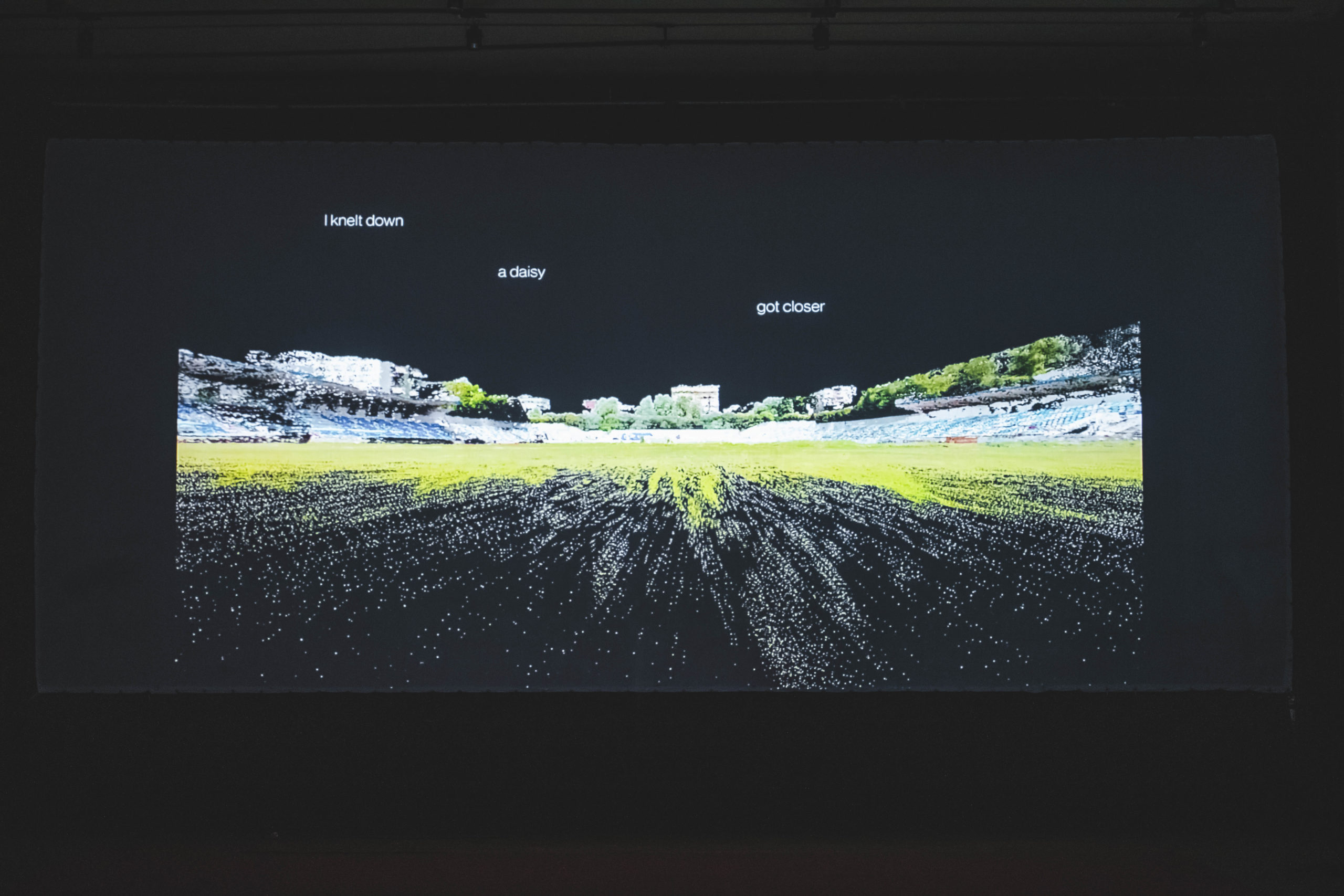
I Accidentally Stepped on a Flower (Eneos Çarka, Stivi Imami, Albania): “Stadion Dinamo was a place of limbo; we entered inside to get away from the loud city,” says the voice in this film, which also opens a dialogue with the flowers. Tirana’s second-largest stadium, a socialist relic long past its prime, stands frozen in time. In the wish to rethink and reimagine this space, the author creates a breathtaking sensory and surreal experience.
Author: Ivona Djuric
Photo Credits: Anibar / Elmedina Arapi